


Shipper | Best practices 6 min. read
Top four international freight strategies for U.S.-Mexico shipping
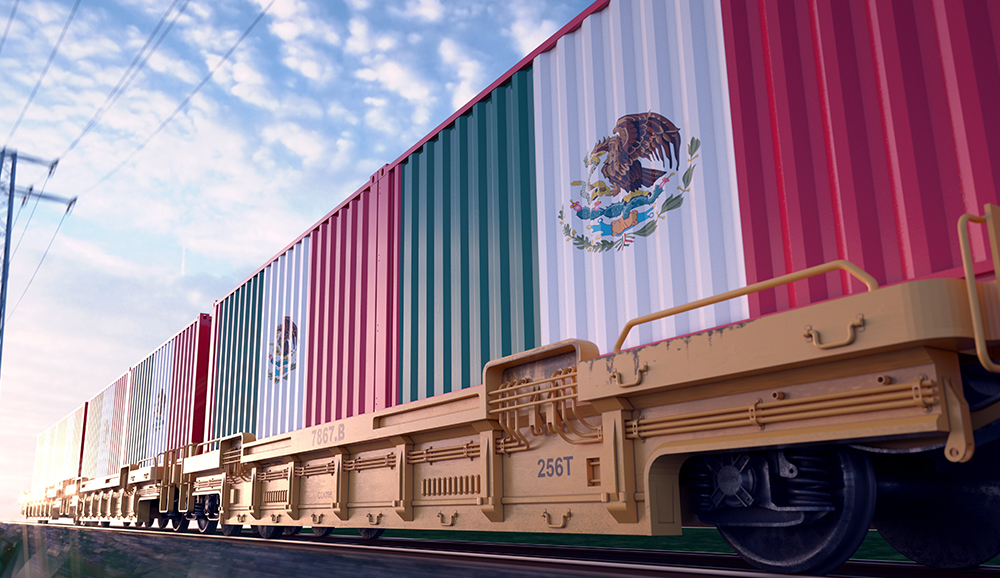
U.S.-Mexico cross-border shipping requires a transportation network that can adapt as freight volumes, capacity availability, regulations and market conditions change. Shippers that build flexibility into their strategy are better positioned to protect service, maintain control and keep freight moving across a complex operating environment.
That flexibility cannot be created shipment by shipment. It requires the right mix of transportation modes, in-country expertise, effective cargo-security practices and efficient network design. This guide outlines four best practices for international shipping strategy that can help shippers build a more reliable and flexible U.S.-Mexico freight operation.
Key takeaways
- Build flexibility into your cross-border strategy by incorporating both truckload and intermodal options before capacity constraints or disruptions occur.
- Work with transportation providers that have a strong presence in Mexico and can help you understand changing regulations, market conditions and operational risks before they impact freight.
- Create a more reliable U.S.-Mexico freight network by combining proactive security practices, local expertise and ongoing network optimization.
Strategy 1: Build multimodal options into your capacity strategy
A flexible cross-border network begins with a clear understanding of the capacity available in each market and the transportation modes that can support the freight.
Understand the cross-border capacity imbalance
Capacity within Mexico is affected by an ongoing imbalance between northbound and southbound freight. The supply of southbound equipment entering Mexico does not always align with the equipment needed to move exports north, creating capacity imbalances.
That challenge is more pronounced when freight originates farther from the border. Repositioning empty equipment from the border to locations farther south adds distance and cost. Conditions also vary by market, which means shippers should evaluate capacity surrounding their specific plants, suppliers and origins instead of treating Mexico as one transportation market.
Use the right mode for the freight
A multimodal approach is no longer simply a backup plan to consider after truckload capacity becomes unavailable. It is an essential part of proactive cross-border planning.
That does not mean converting every shipment to intermodal. Shippers should assess their lanes and determine where truckload, intermodal or a combination of the two makes sense. Shorter or time-sensitive moves may remain better suited for truckload. Intermodal can provide additional capacity for higher-volume freight and longer distances, particularly when repositioning empty truckload equipment becomes difficult.
Have options ready when disruption occurs
A multimodal strategy also provides transportation options. When truckload and intermodal are already incorporated into the plan, shippers can more easily adjust the mix when a bridge, route or mode becomes unavailable.
Neither mode is immune to disruption. The advantage comes from having reliable alternatives ready instead of trying to establish them after freight stops moving.
How Schneider helps shippers build a multimodal strategy
One of the best practices for international shipping strategy is to build a flexible mix of truckload and intermodal capacity. Schneider helps shippers do just that, allowing them to adjust as market, capacity or infrastructure conditions change.
This support includes:
- Assessing lanes, shipment characteristics and market geography to identify where truckload, intermodal or a combination can best support the freight
- Providing access to a broad portfolio of cross-border service offerings, including Truckload, Intermodal, Dedicated, Brokerage, Bulk and other logistics capabilities
- Helping shippers establish reliable capacity alternatives before disruption occurs, strengthening supply chain resilience and making it easier to adjust the modal mix
- Using regularly maintained, company-owned equipment in Mexico to maintain greater control over equipment availability and support more reliable cross-border capacity
- Using a CDL driver model for U.S. freight moves to support consistent execution across the shipment journey
- Helping shippers balance capacity, service, transit and cost considerations rather than choosing a mode based on cost alone
Strategy 2: Work with a provider that has in-country expertise
Cross-border transportation decisions are shaped by more than rates, routes and available equipment. A provider with an established presence in Mexico can help shippers understand local conditions, recognize how developments may affect their freight and prepare an informed response.
Understand the regulatory environment on both sides of the border
Freight shipping internationally requires more than placing a truck on the road or a container on the rail. Providers also need to understand regulations, customs processes, politics, trade developments and enforcement practices on both sides of the border.
Changes in these areas can alter existing processes and affect the transportation options available to shippers. Sometimes the source is new legislation. In other cases, an existing law may begin to be enforced more rigorously, reducing capacity or changing how freight can move.
“Shippers may see capacity tightening at a plant without immediately connecting it to a change in legislation or enforcement,” said Bernardo Rodarte, vice president of Mexico operations at Schneider.
“Our team in Mexico helps connect those dots and explain what the change means for their operation.”
Use local knowledge and relationships to act sooner
A provider with knowledge of the Mexican market can identify developing issues, explain how they may affect transportation and help the shipper prepare a response. That guidance turns information into something the shipper can use to make decisions.
Local relationships are an important part of that expertise. Established connections with authorities, security specialists and the transportation community can give a provider a clearer understanding of what is happening on the ground.
A physical presence in Mexico also allows providers to move beyond monitoring conditions from afar. When issues arise, they can visit facilities, assess the situation firsthand and work directly with local teams to support faster problem-solving.

How Schneider provides in-country expertise
Effective cross-border service depends on people who understand the market, not simply a transportation network that reaches it. Schneider’s team in Mexico helps shippers understand changing conditions, assess the effect on their freight and act sooner.
This support includes:
- Maintaining an in-country team with several decades of boots-on-the-ground experience and a deep understanding of local regulations, customs, transportation practices and regional capacity dynamics
- Bringing local knowledge of Mexico’s infrastructure, ports and border crossings to cross-border planning and execution
- Monitoring regulatory, political and transportation developments that could affect cross-border freight and translating developments into practical guidance for shippers
- Employing more than 100 bilingual, Mexico-based associates to facilitate clearer communication among the parties involved in cross-border transportation
- Operating primarily from locations in Mexico City and Laredo, Texas
- Leveraging strong relationships with local authorities and members of Mexico’s transportation and shipping communities to stay close to changing conditions
- Helping shippers put appropriate processes and transportation options in place before a change begins affecting their freight
- Providing direct, collaborative support from teams in Mexico who can visit facilities, assess issues firsthand and help shippers respond to changing conditions more quickly
Strategy 3: Strengthen security across the shipment journey
Protecting cross-border freight requires a responsible, coordinated approach throughout the shipment journey.
Evaluate the carrier’s security practices
Not every carrier approaches cross-border security the same way. Before selecting a carrier, shippers should ask how it protects freight and look for clear evidence that its security procedures are consistently applied.
Shippers should ask whether the carrier:
- Uses technology to track the location of trailers and containers throughout the shipment
- Has established procedures for moving freight through higher-risk routes and regions
- Is CTPAT-certified or works with CTPAT-certified carriers and other providers that meet defined security requirements
- Has relationships with Mexican authorities and security specialists that can provide insight into changing risks
- Can explain how security protocols change based on the freight, route and level of risk
- Has a clear process for responding to a security issue if one occurs
Make security a shared responsibility
Protecting freight requires coordination among shippers, facilities, transportation providers and security specialists. Actions shippers can take include:
- Pursuing CTPAT certification to add another layer of security to the supply chain
- Selecting a carrier with established freight-security procedures
- Evaluating whether facilities and routes are in areas with an elevated theft risk
- Using specialized security services for higher-risk cargo or corridors
- Considering additional security measures, such as cargo-door locks, when the freight, route or risk profile warrants them
Reduce preventable exposure
There are many safeguards shippers can use to protect cross-border freight. The right security plan should account for the characteristics of each shipment, including the freight, route, facility and level of risk.
Although specific requirements will vary, some basic security practices apply to many cross-border shipments:
- Trucks should arrive with sufficient fuel to reduce unnecessary stops.
- Tractors and trailers should be in sound mechanical condition because a roadside breakdown can leave freight vulnerable.
- Drivers should be prepared to begin the trip without making an immediate stop.
- Planned stopping locations should account for route-specific security conditions.
How Schneider strengthens security across the shipment journey
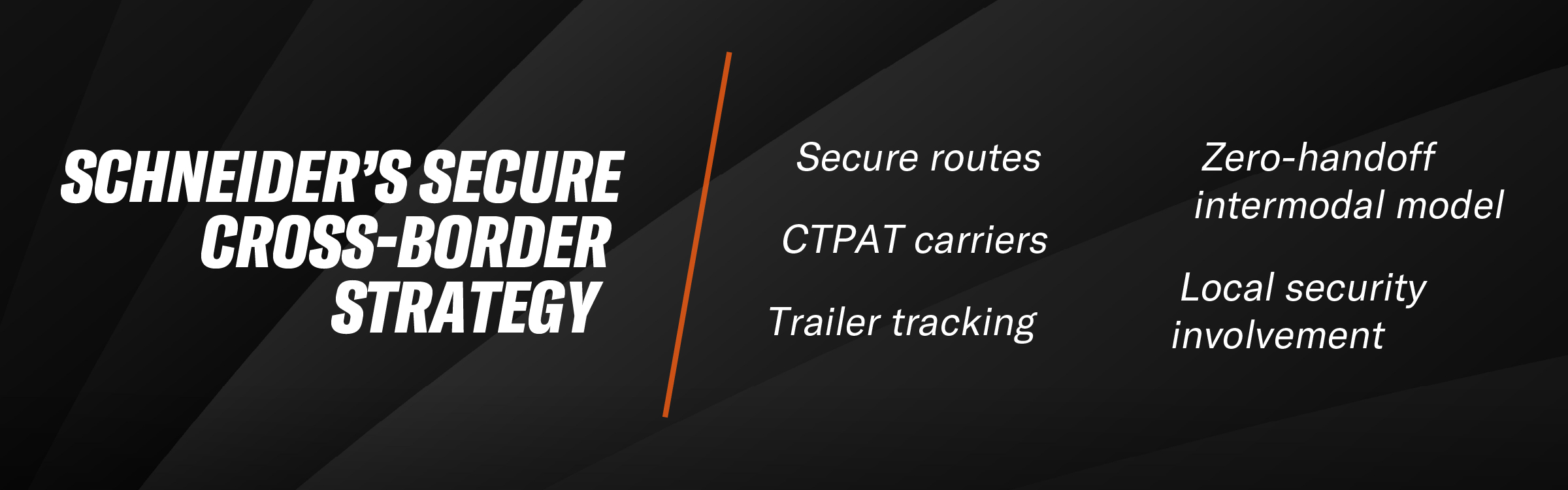
Schneider has achieved a 99.99% cargo security rating across its U.S. and Mexico operations. It combines equipment visibility, established procedures and on-the-ground relationships to help customers protect international cargo freight throughout the cross-border journey.
This support includes:
- Using security measures designed around cross-border conditions and the risks associated with specific routes and shipments
- Working with CTPAT-certified carriers within its defined cross-border operating model
- Using Schneider-controlled GPS technology on trailers and containers to provide direct visibility into equipment location
- Using a zero-handoff Intermodal border-crossing model that can reduce changes in freight custody during the crossing process
- Building relationships with Mexican authorities and security specialists
- Communicating regularly with security experts, including Overhaul, to understand emerging risks and identify opportunities to strengthen procedures
- Helping shippers evaluate routes, stopping practices and other operational factors that can reduce freight exposure
Strategy 4: Engineer the cross-border network for greater efficiency
Inefficiencies can become embedded in a cross-border network over time, but smart shippers prioritize continuous improvement and look for ways to reduce complexity, create density and use transportation resources more effectively.
Look beyond the individual shipment
When capacity or transportation costs are under pressure, it can be tempting to focus on the price and performance of individual loads. However, the structure of the broader network may reveal more meaningful opportunities.
Shippers can examine whether their network creates enough freight density, whether current flows add avoidable distance and whether warehouse or distribution locations align with where products ultimately need to go.
Questions to consider include:
- Are pickup points, consolidation locations and warehouses positioned to support current freight flows?
- Are significant volumes moving through a facility that adds unnecessary distance or complexity?
- Could freight be divided among different facilities or modes to serve its destination markets more effectively?
- Are there opportunities to create density that could improve transportation planning?
These questions are a starting point for evaluating the broader network. Learn more about strategies for improving supply chain efficiency, including network optimization, performance measurement, visibility and scenario planning.
Improve loading practices
Network efficiency also includes what happens inside the facility. Shippers may experience recurring product damage or discover that a shipment does not meet U.S. weight requirements without realizing that the loading configuration may be contributing to the problem.
“How freight is loaded can affect both weight compliance and product condition,” notes Rodarte. “In some cases, adjusting the way the weight and products are distributed within the equipment can correct an overweight axle and help prevent damage caused by improper loading."
How Schneider engineers cross-border networks
Schneider helps shippers examine facility locations, freight flows and loading practices to identify practical opportunities for gaining greater cross-border efficiency.
This support includes:
- Analyzing the shipper’s cross-border network and operating conditions to recommend opportunities to reduce unnecessary distance and complexity, improve freight flows and gain efficiency
- Identifying opportunities to create freight density and improve transportation planning
- Evaluating whether warehouse, pickup, consolidation and distribution locations align with freight destinations
- Using professional loading engineers and other logistics associates who can visit customer facilities, including facilities in Mexico, to identify opportunities to distribute weight properly, meet U.S. transportation requirements and reduce product-damage risk
- Collaborating with individuals responsible for daily execution at facilities in Mexico so recommendations reflect the customer’s actual operating environment
Build readiness before disruption occurs
A resilient cross-border strategy does not depend on one mode, one capability or one contingency plan. It gives shippers reliable options and the information needed to use them effectively.
Shippers are better positioned to maintain control when they:
- Build multimodal flexibility into their transportation plans
- Work with people who understand local conditions in Mexico
- Align facility and carrier security practices
- Continually evaluate whether the network is operating efficiently
International freight shipping becomes more manageable when capacity options, local expertise, security practices and network guidance work together. Schneider makes cross-border complexity easier to manage by giving shippers access not only to capacity, but also to experienced people who can clarify changing conditions, support better decisions and help keep freight moving.
Explore cross-border solutions
Make international freight shipping more manageable with transportation options, greater visibility and practical support when conditions change. Get a quote and discover how Schneider can help make your U.S.-Mexico freight network more flexible and resilient.
Related resources
Drive your business forward
Sign up to receive our industry leading newsletter with case studies and insights you can put to use for your business.


